- Type
- Shrub or tree
- Status in NSW
- Should not be sold in parts of NSW. All land managers have a general duty to reduce its spread.
Large-leaf privet, also called broad-leaf privet, is a fast-growing tree from China that has taken over many of our creeks and rivers. Birds love its berries, so it spreads quickly. Left alone it forms dense stands where no native plants can grow.
How to identify it
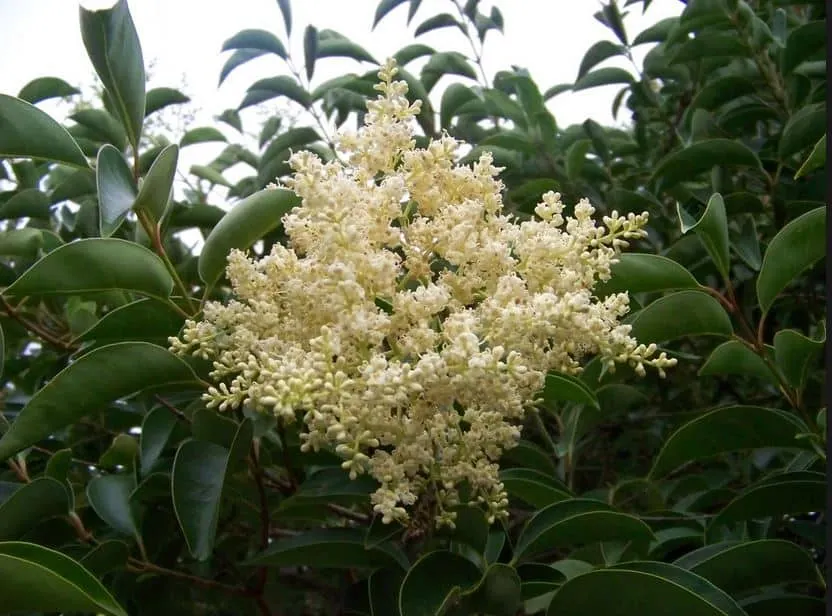
Large-leaf privet usually grows 4 to 10 metres tall with a single trunk and a rounded canopy. Look for:
- glossy, dark green, oval leaves 4 to 13 cm long with pointed tips, in opposite pairs
- clusters of small, sweet-smelling, cream flowers in spring and summer
- bunches of berries that ripen from green through red and blue to purplish-black, heavy on the trees in autumn and winter
- brown bark with small white spots
Small-leaf privet (Ligustrum sinense), also a weed in our area, is smaller, with leaves up to 5 cm. The native mock olive has rougher leaves with more obvious veins.
Where it grows
Privet grows best along creeks and rivers on fertile soils, but it also invades rainforest, eucalypt forest, pasture and gardens. Its seedlings grow well in deep shade, so it can come up under existing bush.
Why it's a problem
- It forms dense thickets that crowd out native plants.
- It threatens endangered ecological communities on North Coast floodplains, including River-Flat Eucalypt Forest and Subtropical Coastal Floodplain Forest.
- It reduces food and shelter for native animals and blocks access to waterways.
- The berries and leaves are mildly toxic if eaten in large amounts, and the flower scent can irritate people with allergies.
How to control it
Remove privet before it seeds, and come back to check for seedlings.
- Pull seedlings and young plants (stems up to 2 to 3 cm thick) after rain, when the soil is soft.
- Cut and paint: cut young plants, suckers and regrowth and treat the stump within 15 seconds.
- Basal bark spraying or stem injection works on larger trees, and stem injection suits trees growing among plants you want to keep.
- Spot spray actively growing plants up to 3 metres.
- Replant the cleared area with local natives.
Always follow the herbicide label.
Safety and disposal
- Wear gloves, and don't eat any part of the plant.
- Don't dump privet in bushland. Bag berries, or let cut material dry out away from creeks.
- Avoid heavy machinery on steep slopes and creek banks, where soil disturbance causes erosion.
Stopping it coming back
- Remove privet from gardens and hedges before birds spread the berries.
- Never dump garden waste.
- Check creek lines each year for seedlings, and replant bare ground with natives.